Cash versus accrual accounting—it’s one of those topics that trips up small business folks. But hey, it doesn’t have to be a headache. Choosing the right method isn’t just paperwork; it hits your taxes, cash flow, and real view of your business.
Let me walk you through it step by step, so you pick what’s best without any confusion.
What Cash vs Accrual Accounting Means
Here’s the simplest way to think about it:
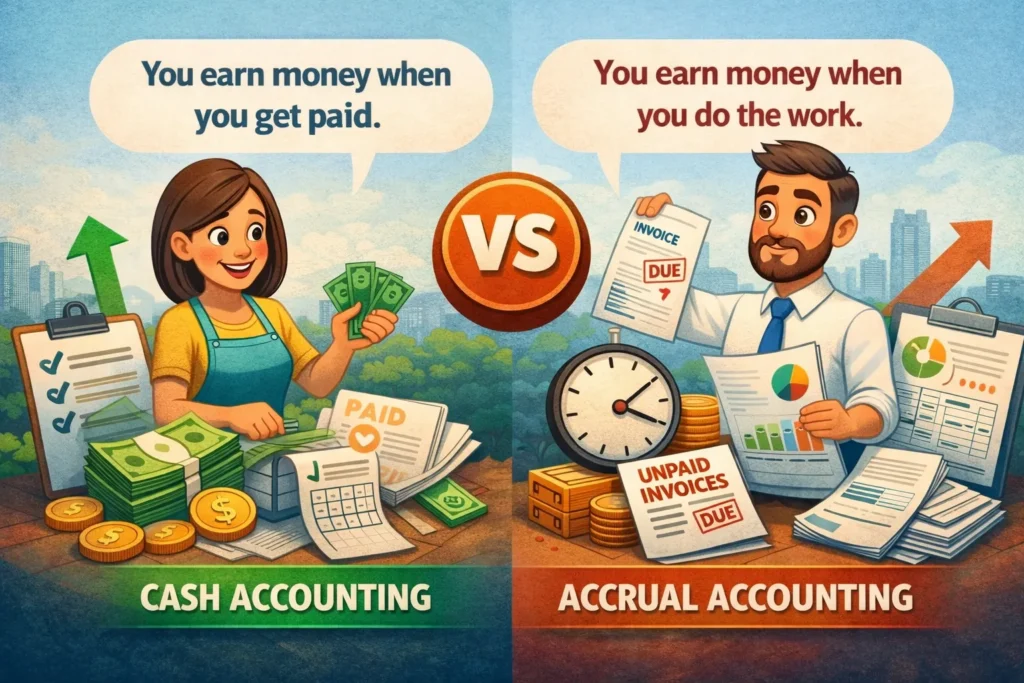
- Cash accounting is like your personal bank account. You record income when the money actually lands in your account. You record expenses when you pay them. Easy to understand.
- Accrual accounting is more like a “real business view.” You record income when you earn it—even if the client hasn’t paid yet—and expenses when they happen, not when the cash leaves your account.
In short, cash accounting answers “what’s in my pocket?”, while accrual accounting answers “how is my business really doing?”
| Feature | Cash Accounting | Accrual Accounting |
| When income is recorded | When payment is received | When income is earned |
| When expenses are recorded | When paid | When incurred |
| Complexity | Simple | More complex |
| Tax planning | Easy | Needs careful planning |
| Best for | Small businesses, freelancers | Growing businesses, LLCs |
Pros and Cons of Cash vs Accrual Accounting
Let’s break down cash vs accrual accounting pros and cons so it’s easier to see which might work for your business:
Cash Accounting Pros
- Super easy to track
- Shows exactly how much cash you have on hand
- Bookkeeping costs are low
- Perfect for small businesses and solo entrepreneurs
Cash Accounting Cons
- Doesn’t show unpaid invoices
- Can make your business look healthier than it really is
- Harder to plan for growth
Accrual Accounting Pros
- Gives a true picture of your business performance
- Helps with budgeting and forecasting
- Required if you want to follow GAAP standards
- Essential if you’re seeking investors or loans
Accrual Accounting Cons
- More complex
- Needs accounting software or a bookkeeper
- Cash flow can feel tight even if profits look good
Cash vs Accrual Accounting for Small Businesses in the USA
So, which is better? Here’s how most small business owners think about it:
- Cash accounting works well for very small businesses, service-based businesses, or businesses that mostly deal in cash.
- Accrual accounting is better for LLCs, businesses with inventory, or companies planning to scale quickly.
It’s also important to consider cash vs accrual accounting tax implications USA—the IRS has specific rules about who can use which method.
IRS Rules for Cash vs Accrual Accounting
Here’s what the IRS says:
- Businesses with inventory must use accrual accounting for sales and purchases.
- Most small service-based businesses can stick with cash accounting.
- If you want to change from cash to accrual, you need approval from the IRS.
Choosing correctly can save you headaches and prevent tax surprises.
When to Switch from Cash to Accrual Accounting
Starting with cash accounting is common. But many businesses eventually switch. Here’s when it makes sense:
- You’re offering credit to customers or have unpaid invoices piling up
- You need accurate financial statements for investors or banks
- Your business has inventory
- You want to forecast and plan more effectively
Switching isn’t instant—it takes planning and IRS approval—but it can make a big difference as your business grows.
Choosing the Best Accounting Method
Here’s a simple rule of thumb for accounting methods for small business:
- LLCs & Sole Proprietorships: Cash accounting is often enough if the business is simple.
- Businesses with inventory: Accrual accounting is usually required.
- Businesses planning rapid growth: Accrual accounting gives a better view of profits and expenses.
In other words, the best accounting method for LLC USA depends on size, complexity, and growth plans.
Tax Implications
Taxes are one of the main reasons this choice matters:
- Cash accounting: You pay taxes only on money you’ve actually received. That can help with tax planning if income comes in late in the year.
- Accrual accounting: You pay taxes when income is earned, even if you haven’t received the money yet. This can make cash flow management trickier.
Working with an accountant is smart—they can help you make the choice that minimizes taxes and maximizes cash flow.
Tools to Manage Cash vs Accrual Accounting
You don’t have to do this manually. Modern software can make either method manageable:
- QuickBooks Online – tracks cash and accrual reports
- Xero – lets you choose your accounting method
- FreshBooks – ideal for small service businesses
- Wave – free option for simple cash accounting
Quick Decision Table
Here’s a handy guide for deciding between cash vs accrual accounting:
| Situation | Recommended Method |
| Small service-based business | Cash |
| Business with inventory | Accrual |
| Planning to seek investors or loans | Accrual |
| Limited cash flow but steady income | Cash |
| Expanding rapidly or offering credit sales | Accrual |
Conclusion:
Cash vs accrual accounting affects taxes, growth, and financial visibility. It is simple, easy to understand, and works for most small businesses. Accrual accounting shows the true health of your business, especially if you carry inventory or plan to grow.IRS rules matter—choose correctly from the start or get approval to switch later.
Frequently Asked Questions
Which one’s better for small businesses in the USA?
Go with cash accounting if you’re a small shop dealing mostly in cash—it’s dead simple. Switch to accrual if you’re an LLC with inventory or planning to grow.
Can an LLC pick between cash and accrual?
Sure, most LLCs get to choose. But if you handle inventory, you might have to stick with accrual.
How does cash versus accrual affect your taxes?
With cash, you pay taxes on money when it hits your account. Accrual means taxing it when you earn it, even if the cash hasn’t shown up yet.
When should you switch from cash to accrual?
Make the jump if your sales are picking up, you’re offering credit to customers, or you need solid financials to impress investors or banks.
Are there IRS rules on cash versus accrual?
Yep, if you deal with inventory, the IRS says use accrual. And if you want to switch methods, you need their okay first.
Pros and cons of cash accounting?
Pros: super simple and shows exactly what’s in your pocket. Cons: ignores unpaid bills, so it doesn’t tell the full story of your business.
Pros and cons of accrual accounting?
Pros: gives you a real, accurate view for better planning. Cons: more complicated—you’ll probably need software or a bookkeeper.
Can you mix cash and accrual methods?
You can use hybrids, but they have to follow IRS rules and stay consistent for tax time.
Best software for cash or accrual accounting?
QuickBooks, Xero, FreshBooks, or Wave all handle both great. I’d tell most growing businesses to start with QuickBooks.