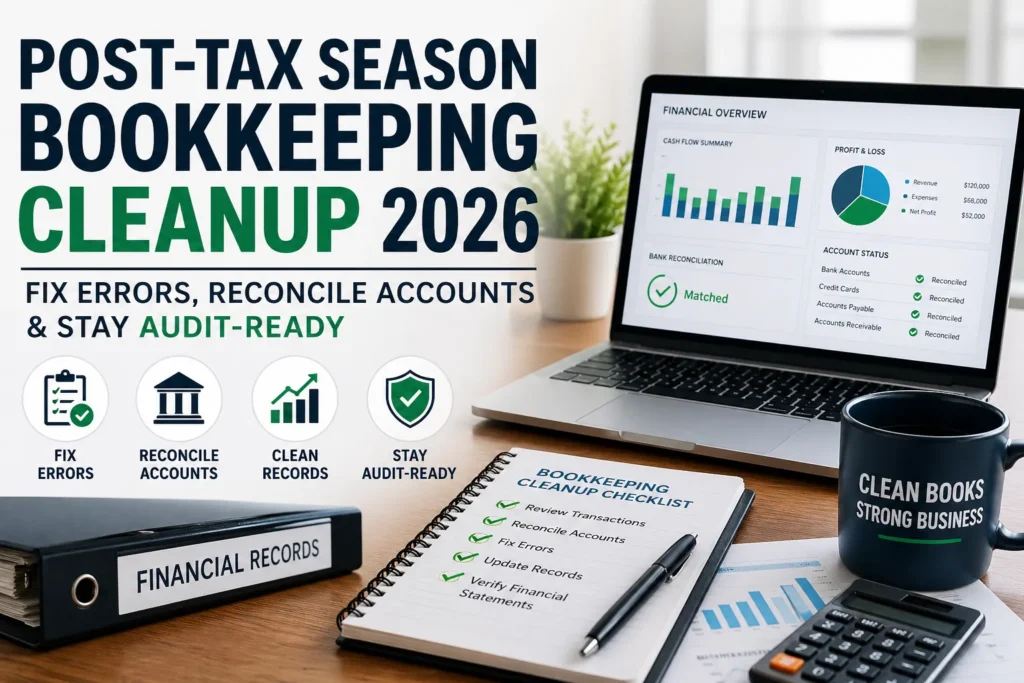
Tax season bookkeeping cleanup is that stage right after tax filing where things finally get corrected, aligned, and made sense of. Taxes may be done, but the books usually still carry gaps, small errors, and mismatched numbers that were ignored during the busy year.
It is basically going back into the financial records and cleaning everything properly so the numbers reflect what actually happened in the business, not what was accidentally recorded.
It matters because clean books are what support good decisions, smooth audits, and stress-free financial planning.
Why This Cleanup Really Matters
A lot of businesses assume everything is fine after tax filing, but that is usually not true.
Tax season bookkeeping cleanup brings everything back into reality.
- It shows the real profit without errors hiding in the system
- It corrects bank balances that never matched properly
- It fixes mistakes that built up quietly over time
- It reduces confusion when making financial decisions
- It keeps audit risk much lower
Without tax season bookkeeping cleanup, the numbers may look fine but they are not fully reliable.
What Usually Goes Wrong in the Books
When tax season bookkeeping cleanup starts, the same issues appear again and again.
- Payments recorded twice by mistake
- Income entries missing completely
- Expenses placed in wrong categories
- Bank records not matching accounting clean up books
- Old invoices still marked as unpaid
These are not big dramatic errors, but small ones that pile up over time until tax season bookkeeping cleanup exposes them.
Simple bookkeeping cleanup checklist before tax season
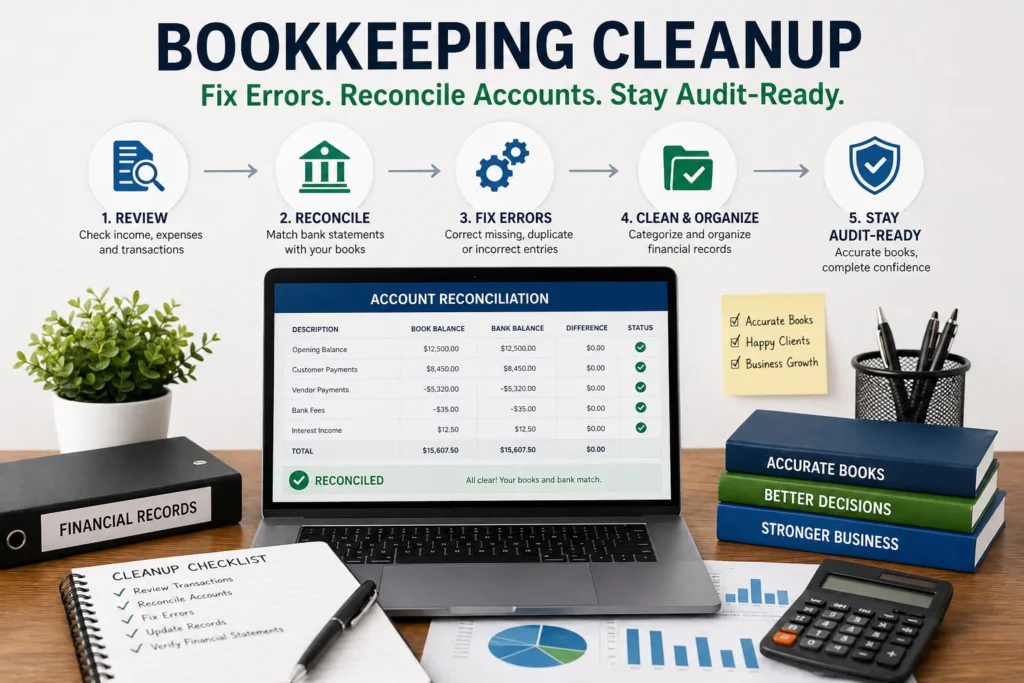
A proper tax season bookkeeping cleanup always follows a structured flow with reconcile accounts.
- Review all income and match with invoices
- Check all expenses with receipts
- Reconcile all bank accounts
- Find missing or duplicate entries
- Review payroll and salary records
This makes tax season bookkeeping cleanup less overwhelming and more controlled.
Reconciliation Made Simple
At the heart of tax season bookkeeping cleanup is reconciliation, which simply means checking if books match the bank.
{Bank Balance} – {Book Balance} = {Difference to Fix}
Here is how it is usually done:
- Start with bank statement
- Match each transaction with accounting records
- Mark what is correct and what is missing
- Fix differences one by one
This step in tax season bookkeeping cleanup is where most hidden issues are found.
How the Cleanup Process Feels
Tax season bookkeeping cleanup often feels like sorting through a messy room that has not been touched in a while.
- At first, everything looks confusing
- Then patterns start to appear
- Errors become easier to spot
- Finally, everything starts to align clearly
Once tax season bookkeeping cleanup is done, the difference in clarity is immediate.
Why Small Businesses Struggle More
For small businesses, tax season bookkeeping cleanup feels heavier because systems are often not strict enough.
- Business and personal expenses get mixed
- Records are not updated regularly
- Bank reconciliation is delayed
- Receipts are sometimes missing
This is why consistent tracking and small business bookkeeping tips matter so much throughout the year.
When Professional Help Is Needed
Sometimes tax season bookkeeping cleanup becomes too large to handle alone.
- Months of missing records
- High number of transactions
- Urgent audit requirements
- Fast business growth
In these situations, bookkeeping cleanup services help restore order faster and more accurately.
Year-End Financial Reset
A complete tax season bookkeeping cleanup ends with a final financial review.
- Profit and loss is checked properly
- Balance sheet is verified
- Expenses are corrected and categorized
- Adjustments like depreciation are recorded
This year-end bookkeeping checklist ensures nothing is left incomplete.
Tools That Make Cleanup Easier
Modern tax season bookkeeping cleanup becomes much smoother with the right tools.
- Accounting software for tracking everything
- Bank sync tools for automatic matching
- Expense apps for receipt capture
- Spreadsheets for manual checks
These tools support tax season bookkeeping cleanup, but do not replace the process itself.
What Changes After Cleanup
Once tax season bookkeeping cleanup is done properly, everything feels more stable.
- Numbers finally match reality
- Cash flow becomes easier to understand
- Reports become more reliable
- Planning becomes clearer and more confident
Without tax season bookkeeping cleanup, decisions are often based on incomplete information.
Audit Readiness
Another major benefit of tax season bookkeeping cleanup is audit readiness.
- Every transaction can be traced
- Documents are properly organized
- Books match bank records completely
- Errors are already corrected
This makes financial reviews much easier and less stressful.
Conclusion:
Tax season bookkeeping cleanup is not just a correction task, it is a full financial reset. It brings clarity back into the system, removes confusion, and makes the business financially stable again.
When tax season bookkeeping cleanup is done properly, everything that follows becomes easier, from reporting to planning to decision-making.
Frequently Asked Questions
What is tax season bookkeeping cleanup in simple terms?
Tax season bookkeeping cleanup is the process of fixing and organizing financial records after tax filing so that all numbers are accurate, matched, and properly recorded.
Why is tax season bookkeeping cleanup important after filing taxes?
Tax season bookkeeping cleanup is important because tax filing does not correct accounting mistakes, it only reports them. Cleanup ensures financial records are accurate and reliable.
What problems are usually fixed during tax season bookkeeping cleanup?
Tax season bookkeeping cleanup fixes missing entries, duplicate transactions, incorrect expense categories, and mismatched bank statements.
How does the accounts reconciliation process work in tax season bookkeeping cleanup?
Reconciliation in tax season bookkeeping cleanup means matching bank statements with accounting records to ensure every transaction is correctly recorded and balanced.
Can tax season bookkeeping cleanup be done manually?
Yes, tax season bookkeeping cleanup can be done manually using spreadsheets and bank statements, but it takes more time and increases the risk of errors.
When should tax season bookkeeping cleanup be done?
Tax season bookkeeping cleanup is usually done right after tax filing or at the end of the financial year to reset and correct financial records.
Who needs tax season bookkeeping cleanup services?
Businesses with messy records, delayed bookkeeping, or audit requirements often need tax season bookkeeping cleanup services to restore financial accuracy.
What tools help in tax season bookkeeping cleanup?
Accounting software, bank syncing tools, and expense tracking apps help make tax season bookkeeping cleanup faster and more accurate.
What is included in bookkeeping cleanup services?
Bookkeeping cleanup services include reconciliation, error correction, expense categorization, missing entry updates, and financial statement corrections.
How does tax season bookkeeping cleanup help businesses long-term?
Tax season bookkeeping cleanup improves long-term financial clarity, reduces errors, supports better decisions, and makes future tax filing easier and more accurate.