
Revenue Leakage is something many businesses don’t notice until it becomes a real financial problem. It doesn’t show up loudly. It doesn’t shout. It just slowly drains money from different parts of the business without being clearly seen.
It happens when money that should come into the business doesn’t fully arrive. Sometimes it’s small billing mistakes. Sometimes it’s missed invoices. Sometimes it’s expenses that no one really tracks properly. Over time, revenue starts affecting overall business health.
And here’s the simple truth. Revenue doesn’t happen once. It keeps repeating if systems are weak.
That’s why Revenue Leakage is one of the most important things to understand if the goal is to improve Small Business Profitability and keep strong Cash Flow Management in place.
What Revenue Leakage Really Means?
Revenue Leakage simply means money slipping away from the business without being properly recorded or collected.
It doesn’t always feel like a big loss. It feels small at first. But those small leaks build up quietly.
It can come from many everyday business activities like:
- Wrong invoices being sent
- Discounts not tracked properly
- Unbilled work
- Late payments ignored
- Expenses recorded incorrectly
So basically, leakage is not one problem. It’s many small gaps happening together to improve cash flow.
And when those gaps are not controlled, revenue directly impacts Small Business Financial Management.
Why Revenue Leakage Happens in Most Businesses
Most of the time, leakage doesn’t come from one big mistake. It comes from weak systems and habits.
Here are common reasons it starts happening:
- No proper Expense Tracking system in place
- Manual work instead of automation
- Lack of Cost Control Strategies
- No regular review of numbers
- Weak follow-up on payments
- Poor communication between teams
When these things happen daily, it becomes normal without anyone noticing.
And once leakage becomes normal, profit starts shrinking even if sales look fine.
Clear Signs Leakage Is Already Happening
There are always signs. Businesses just don’t always connect them to leakage.
Watch for these:
- Profit feels lower even when sales are stable
- Cash is always tight at the end of the month
- Expenses keep increasing without clear reason
- Reports don’t match actual bank balance
- Payments are getting delayed often
When these signs show up, leakage is usually already active inside the system.
It’s not about guessing. It’s about noticing patterns. leakage always leaves clues in financial behavior.
Where Revenue Leakage Usually Hides
Revenue doesn’t sit in one place. It spreads across operations.
Most common areas include:
Billing system
Small errors in invoices, missed charges, or wrong pricing create without anyone noticing immediately.
Expenses
When Expense Tracking is weak, small costs keep adding up and create silent leakage.
Sales process
Missed follow-ups or uncollected payments also lead to revenue.
Operations
Untracked work or services often result in leakage because nothing is billed properly.
So leakage is not just finance-related. It’s a full business issue.
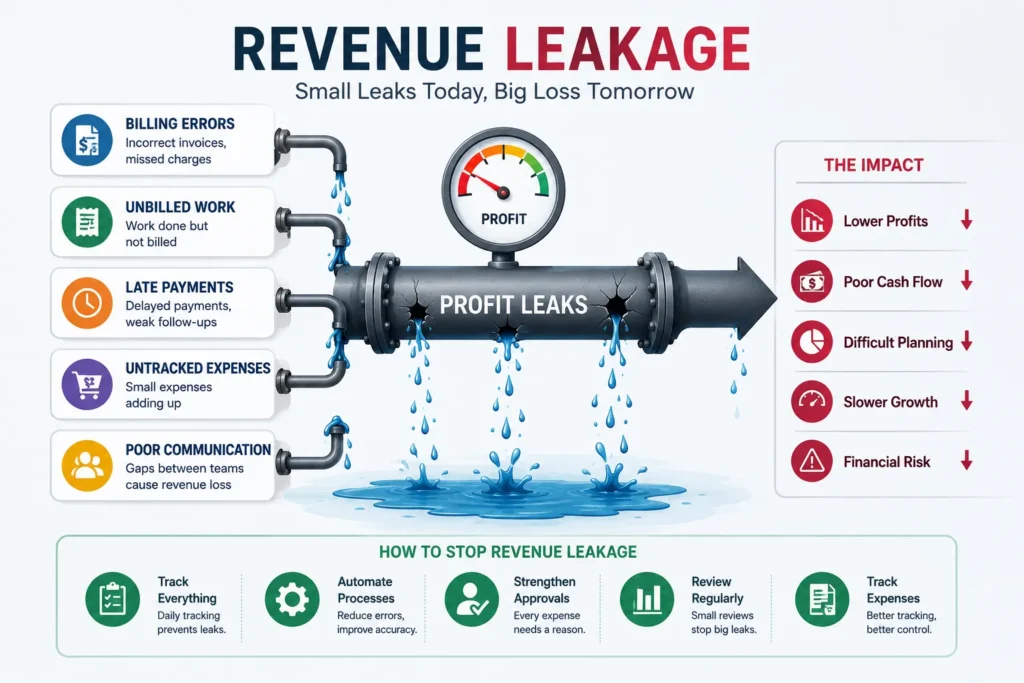
How Revenue Leakage Slowly Impacts Profit
Leakage doesn’t crash a business overnight. It slowly eats into profit.
First, profit margins start shrinking.
Then cash flow becomes unstable.
Then planning becomes difficult.
Then growth slows down.
That’s how leakage works quietly in the background.
It directly affects:
- Cash Flow Management
- Profit Margin Improvement
- Business Performance Analysis
- Small Business Profitability
And the worst part is, everything still looks “normal” on the surface.
How to Stop Revenue Leakage Before It Grows
Stopping Revenue is not about one fix. It’s about building control in daily operations.
Here’s what actually works:
Keep financial tracking active daily
Do not wait for month-end. Revenue grows in silence.
Automate invoicing and payments
Manual work increases Revenue risk.
Strengthen approval systems
Every expense should have a reason and approval.
Review reports regularly
Small reviews prevent big Leakage later.
Track every expense properly
Expense Tracking is one of the strongest tools against Leakage.
When these steps are consistent, leakage starts reducing naturally.
Simple Comparison: With and Without Control
| Area | No Control | With Control |
| Billing | Errors common | Accurate invoicing |
| Expenses | Untracked spending | Clear Expense Tracking |
| Cash flow | Unstable | Predictable |
| Profit | Reduces silently | Improves steadily |
This is where Leakage either grows or gets controlled.
Why Businesses Ignore Leakage
Most businesses don’t ignore it on purpose. It just doesn’t look urgent.
Sales feel more important. Growth feels more exciting. Leakage feels invisible.
But the reality is simple.
Even strong sales cannot fix Leakage if systems are weak.
That’s why Small Business Financial Management always needs equal focus on tracking, control, and review.
Conclusion
Revenue Leakage is not just about losing money. It’s about losing control slowly without noticing it.
Once leakage is identified early, it becomes very manageable.
But when ignored, it turns into a long-term profit problem.
Strong systems, regular tracking, and simple financial discipline can reduce Revenue Leakage significantly and improve overall Cash Flow Management and Profit Margin Improvement.
Frequently Asked Questions
What exactly is Revenue in a business?
It means money that should be collected by a business but gets lost due to errors, missed billing, or weak tracking systems in daily operations.
Why does Revenue Leakage happen so often?
It happens mostly because of manual systems, poor tracking habits, and lack of proper financial control across different business activities.
How does Leakage affect profit?
It reduces real profit slowly over time, even when sales are strong, because not all earned money is properly collected or recorded.
What is the first sign of Revenue Leakage?
The first sign is usually declining profit margins or cash flow issues even when business activity and sales look normal on the surface.
Can small businesses suffer from Leakage?
Yes, small businesses are even more affected because small losses from leakage build up quickly and impact overall financial stability.
How can Revenue be controlled easily?
Revenue Leakage can be controlled by improving Expense Tracking, automating billing, and reviewing financial reports regularly without delay.
Is Leakage only a finance problem?
No, Leakage also comes from operations, sales, and communication gaps within the business structure.
Does automation help reduce leakage?
Yes, automation reduces leakage by removing human errors and improving accuracy in billing, payments, and tracking systems.
How often should Revenue Leakage be checked?
Leakage should be checked regularly, ideally every month, to catch small issues before they become larger financial problems.
What happens if Revenue Leakage is ignored?
If ignored, leakage keeps increasing quietly, reduces profit margins, and creates long-term cash flow instability in the business.