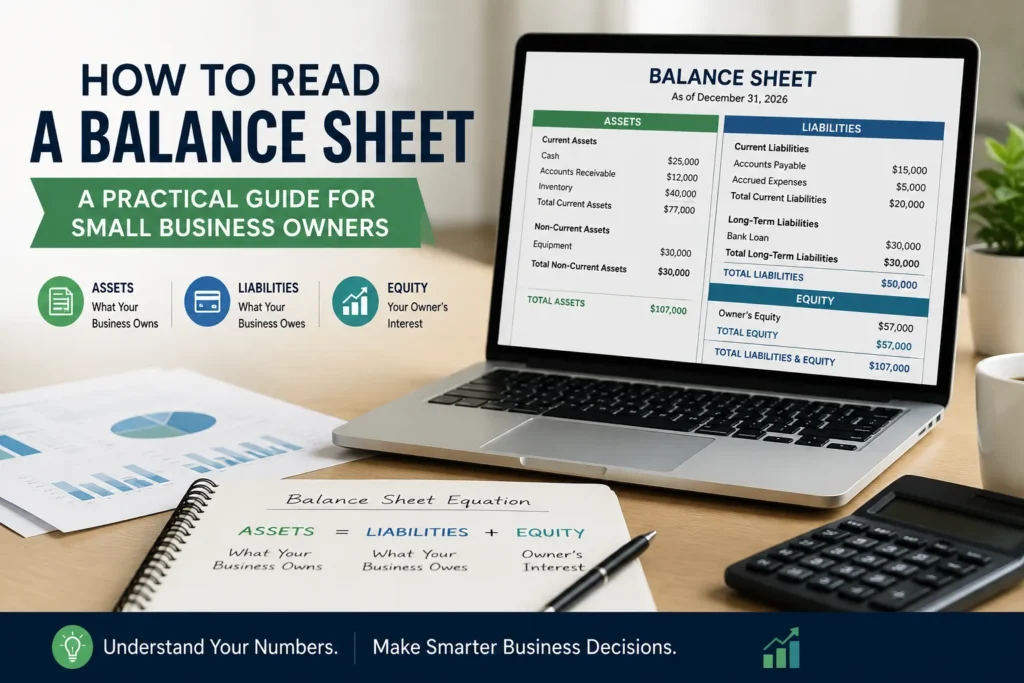
Numbers on a page. Terms you do not fully understand. A document that is supposed to tell you something important but looks like a foreign language. That is how most small business owners feel about their balance sheet.
How to read a balance sheet is not complicated. It follows a simple formula. Once you understand that formula, everything starts making sense.
What Is Meant by Balance Sheet
A balance sheet is a financial statement that shows what your business owns and owes at a specific point in time. A single moment in your business’s financial life.
Unlike an income statement and balance sheet serve different purposes. The income statement shows performance over time. The balance sheet shows position at a single moment.
How does a balance sheet work is straightforward. It follows one equation:
Assets = Liabilities + Equity
This is the accounting equation. It must always balance. Every dollar of assets is either financed by debt (liabilities) or by owner investment (equity).
The Balance Sheet Equation Explained
Assets are what your business owns. Cash, inventory, equipment, accounts receivable, buildings. Liabilities are what your business owes. Loans, accounts payable, credit card balances, taxes owed. Equity is what is left over. It is the owner’s stake. The net worth of the business.
If you own $100,000 in assets and owe $60,000 in liabilities, your equity is $40,000. That is understanding a balance sheet in its simplest form.
How to Read a Balance Sheet: The Three Sections
How to read a balance sheet means understanding its three main sections.
Assets
Assets are listed in order of liquidity. How quickly they can be converted to cash. Current assets are cash or items that will be converted to cash within one year. Cash, accounts receivable, inventory, and prepaid expenses fall here. Non-current assets are long-term resources. Property, equipment, vehicles, furniture, and intangible assets like patents or goodwill.
Liabilities
Liabilities are listed by when they must be paid. Current liabilities are due within one year. Accounts payable, short-term debt, accrued expenses, and the current portion of long-term debt. Long-term liabilities are due after one year. Bank loans, mortgages, and other long-term obligations.
Equity
Equity is what is left after subtracting liabilities from assets. It includes owner investments, retained earnings, and other accumulated profits.
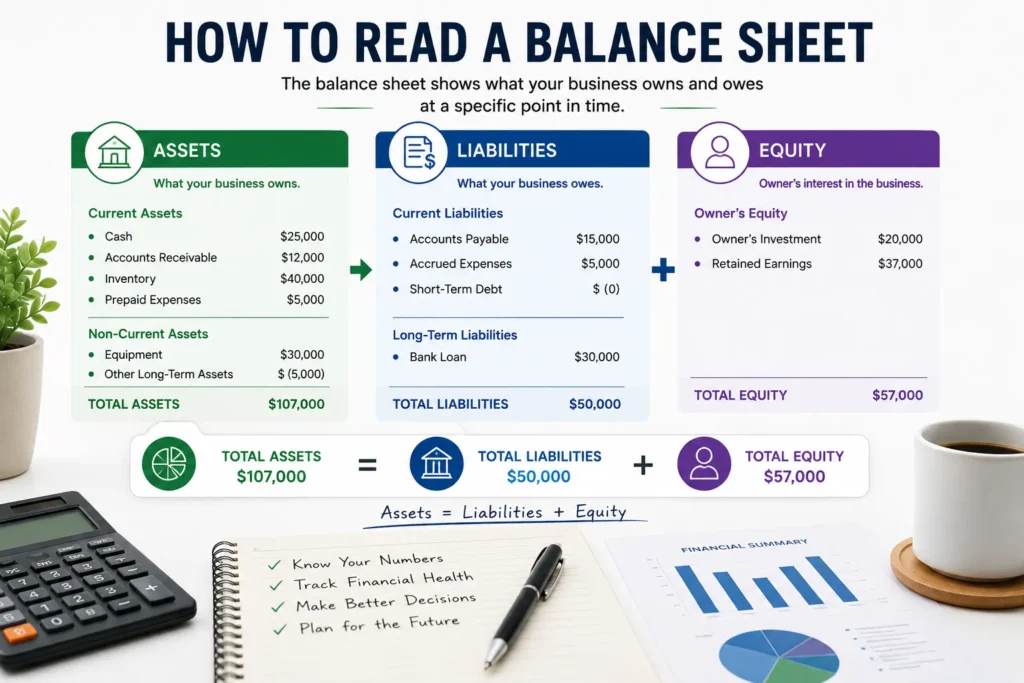
Understanding a Balance Sheet Example
Here is a balance sheet example for a small retail store as of December 31, 2026:
- Assets
Cash: $25,000
Accounts receivable: $12,000
Inventory: $40,000
Equipment: $30,000
Total Assets: $107,000
- Liabilities
Accounts payable: $15,000
Accrued expenses: $5,000
Bank loan: $30,000
Total Liabilities: $50,000
- Equity
Owner’s equity: $57,000
The equation holds: $107,000 assets = $50,000 liabilities + $57,000 equity.
This balance sheet sample is simplified, but it shows the structure. Assets on the left or top. Liabilities and equity on the right or bottom.
How Does a Balance Sheet Work
How does a balance sheet work depends on where the numbers come from. It is built from your general ledger. Every transaction impacts the balance sheet in some way.
Buy inventory with cash. Inventory (asset) increases. Cash (asset) decreases. Total assets unchanged.
Take out a loan. Cash (asset) increases. Loans payable (liability) increases. Total assets and liabilities both increase.
Make a sale on credit. Accounts receivable (asset) increases. Revenue increases equity. The balance sheet expands. The double-entry system ensures the equation always balances
Read Across the Balance Sheet
How to read a balance sheet requires looking for relationships.
- Current ratio. Current assets divided by current liabilities. Above 1 means you can cover short-term obligations. Below 1 is a warning sign.
- Debt-to-equity ratio. Total liabilities divided by equity. A high number means the business relies heavily on borrowing .
- Working capital. Current assets minus current liabilities. Positive means you have resources to cover short-term obligations .
These ratios help interpret the balance sheet sample. They turn raw numbers into actionable insights.
Balance Sheet Example: Reading a Specific Section
Looking at inventory. Is it growing while sales are flat? That could mean slow-moving stock. Is it too low? That could mean stockouts and lost sales. Accounts receivable. Are customers paying on time? A growing balance compared to sales is a red flag.
Accounts payable. Are you using supplier terms effectively? Paying too early or too late both create issues. Loans. Are repayments manageable? The balance sheet shows the total debt, but cash flow will show whether the business can service it.
Assets and Liabilities
Understanding a balance sheet helps you focus on what matters most.
- Cash is king. It keeps the business running. It allows the business to take advantage of opportunities. It also gives the business time to recover from mistakes .
- High liability. It may limit growth. It can have a significant impact on cash flow. Reducing debt is often a sound financial decision .
- Strong equity. Gives the business options. It attracts investors. It provides a cushion for the business.
Conclusion
How to read a balance sheet is essential for any business owner. It is not a mystery. It is simply a snapshot of assets, liabilities, and equity. The equation must always balance. The numbers tell a story about liquidity, leverage, and financial health. Take the time to understand it. Your business will be stronger for it.
Frequently Asked Questions
What is meant by balance sheet?
A balance sheet is basically a snapshot of your business’s finances at a specific moment. It shows what you own that’s assets and what you owe that’s liabilities.
How do I read a balance sheet for my small business?
Start at the top with total assets. Then subtract total liabilities. Whatever’s left is your equity. Then compare current assets to current liabilities that tells you if you can pay your short-term bills.
What is a balance sheet example for a small business?
You got $25,000 in cash, $40,000 in inventory, and $30,000 in equipment. That’s $95,000 in assets. You owe $15,000 in accounts payable and $30,000 on a bank loan – that’s $45,000 in liabilities. Your equity is $50,000. Assets $95,000 equals liabilities $45,000 plus equity $50,000. Always balances.
What is the balance sheet formula?
Assets = Liabilities + Equity. That’s the accounting equation. And it always has to balance always.
What is the difference between a balance sheet and an income statement?
A balance sheet shows your financial position at one specific point in time. An income statement shows how you performed over a period of time like a month or a year. You need both to really understand your financial health.
How does a balance sheet work?
It’s built from your general ledger. Every transaction you make affects the balance sheet somehow. The double-entry system makes sure everything stays in balance.
What is a current ratio on a balance sheet?
It’s current assets divided by current liabilities. It tells you if you can pay your short-term bills. If the number’s above 1, you’re in good shape.
What is the debt-to-equity ratio?
Total liabilities divided by equity. It shows how much your business relies on borrowed money. A higher number means more debt.
What is working capital?
Current assets minus current liabilities. It measures your short-term liquidity. Positive working capital means you got the resources to cover what you owe in the near future.
Why is understanding a balance sheet important for small business owners?
Because it shows you the real picture. Financial health, liquidity, debt, ownership stake, it’s all there. It helps you make better decisions, get loans, and attract investors.