
Running a small business is exhausting. Customers need you. Products need shipping. Employees need management. Accounting gets shoved aside. You cannot grow what you do not understand. And you cannot understand your business without knowing your numbers. That is why you need a monthly financial close process.
Most owners just check their bank balance and call it good. Wrong. That number only tells you what is in the account right now. It says nothing about unpaid invoices. Nothing about bills due next week. Nothing about expenses you already racked up. A proper month-end close process shows you the whole truth.
What Monthly financial close process Really Means
Think of the monthly financial close process like washing dishes. Let them pile up and you have a stinky mess. Wash them daily and everything stays clean. Same deal with your money. Good financial record keeping keeps things straight.
The month-end close process simply means wrapping up all your financial stuff for the month. Every sale gets recorded. Every expense gets checked. Every invoice gets reviewed. Every bank transaction gets matched up.
Do this and you get solid monthly financial reporting. You see exactly where your money came from, where it went, and what is left.
Why Monthly financial close process Matters
Most small business owners have no clue if they are actually making money until tax time. Imagine grinding all year just to find out you have been losing cash for months. That is what happens without a month-end close process.
The monthly financial close process puts you in charge. You spot problems while they are still tiny. Vendor overcharged you? Customer payment missing? Expense coded wrong? Catch these early and they are simple fixes. Let them multiply and you have a disaster on your hands. This is why many owners turn to accounting services for small businesses for help.
This whole thing keeps your cash flowing too. Accounts receivable reconciliation shows who owes you money and for how long. So you can chase late payers before they become a headache. Cash flow management gets way easier when you know what is coming in and going out.
Accounts payable reconciliation makes sure you are not paying bills twice or missing due dates. Late fees eat your profits. A solid month-end close process stops that waste and keeps your general ledger clean.
How to Get It Done
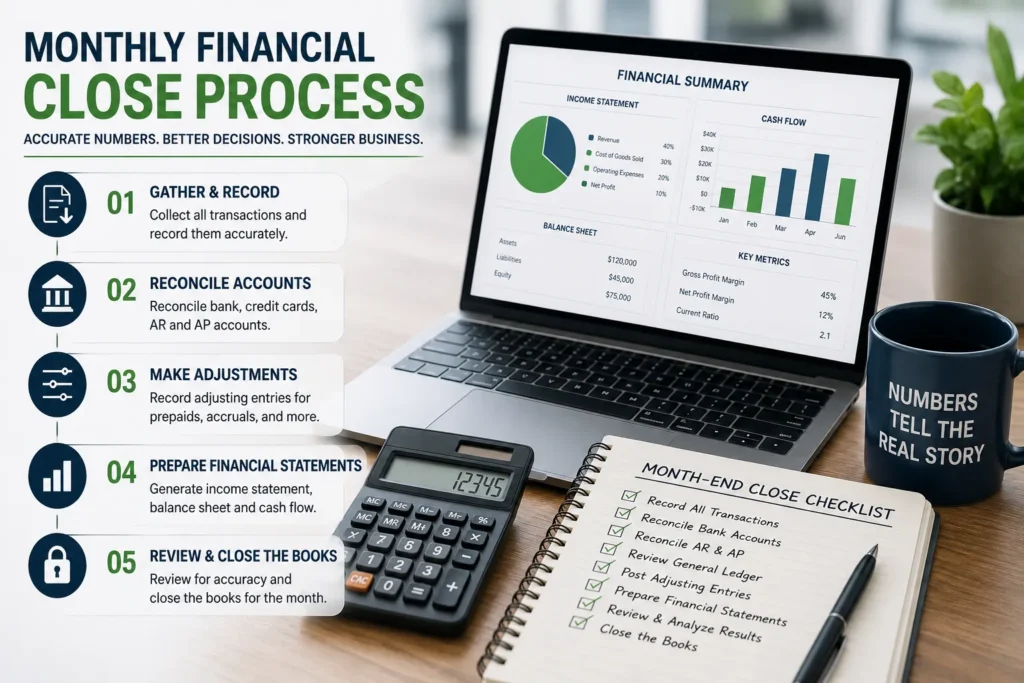
Start by gathering everything. Every transaction belongs in your system. Sales, bills, payroll, all of it. Good financial record keeping starts right here.
Next comes reconciliation. This is the real work. Match your bank records against your own. Match credit cards too. Accounts receivable reconciliation means checking customer payments match invoices. Accounts payable reconciliation means confirming every vendor bill is accounted for.
Your general ledger ties everything together. Reconciliation makes sure it is all correct. Many businesses use accounting services for small businesses to handle this part properly.
Then handle adjustments. Some expenses are prepaid. Some are pending. Adjusting entries make sure your records show reality. This is key for accurate financial statement preparation
Generate your reports after that. Income statement shows if you are profitable. Balance sheet reveals what you own and owe. Cash flow statement track how money moves. That is monthly financial reporting in action.
Finish by reviewing everything and closing the month. Once closed, nothing changes. Your month-end close process is done.
Tips That Work
Build yourself a month-end closing checklist. Write down every task, who does it, and when. Makes the whole thing repeatable. This checklist keeps your financial record keeping on track.
Pick a realistic timeline. Close within five to ten business days after month-end. Keeps your data fresh.
Use technology to help. Monthly bookkeeping services and accounting software do the heavy lifting. Bank feeds import transactions automatically. Reports pop out with a click. Saves you tons of time.
Write down every adjustment you make. Note why you made it. Creates a trail and makes future reviews easier.
When You Skip This
Decisions get made on bad data. Cash problems grow until they blow up. Tax time becomes a frantic rush. Your financial statement preparation turns into a nightmare.
Worst part is you lose real strategy. Are you actually growing? Can you afford to hire? Should you invest? Without proper monthly financial reporting, these are just guesses. Your cash flow management suffers because you simply do not know what is happening.
Conclusion:
The monthly financial close process is non-negotiable. Period. It gives you visibility, control, and real confidence. Solid financial record keeping and regular accounts receivable reconciliation keep your business healthy.
Whether you handle your own monthly bookkeeping services or hire professionals, closing your books every month is essential.
Frequently Asked Questions
How does the monthly financial close process help owners make better daily decisions?
The monthly financial close process gives accurate data on revenue and expenses, helping owners see which products are profitable, and make smart choices about pricing.
Do tiny businesses with few transactions really need to do this every month?
Yes, even with few transactions, this monthly habit ensures accuracy and builds discipline. Regular reviews catch mistakes early.
What are the most mistakes owners make with their monthly financial close process?
Skipping reconciliations, forgetting adjusting entries for prepaid costs, mixing personal and business funds, and not documenting adjustments all create major confusion and issues that are hard to fix later.
How does accounts receivable reconciliation speed up customer payments?
Accounts receivable reconciliation flags overdue invoices so you can follow up fast. It also shows which customers are habitually late.
What software works best for people without accounting experience?
QuickBooks, Xero, and FreshBooks are solid choices. They automate bank feeds, transaction sorting, and report generation.
How do you build a month-end closing checklist that actually gets used?
List every task from start to finish, assign responsibility, set deadlines, review and refine after each close, and update whenever your business changes.
What is the difference between the general ledger and financial statements?
The general ledger holds every detailed transaction record, while financial statements are summarized reports pulled from that data that give you a big picture.
Why does accounts payable reconciliation matter for vendor relationships?
Accounts payable reconciliation ensures every vendor bill is paid accurately and on time, avoiding late fees and keeping supplier trust.
Should busy owners outsource their monthly close to professionals?
Absolutely. Professional accounting services for small businesses handle the entire process accurately and efficiently.
How does monthly financial reporting help with getting loans or investors?
Lenders and investors demand reliable financial data. Monthly financial reporting proves you manage money well and provides the numbers they need.