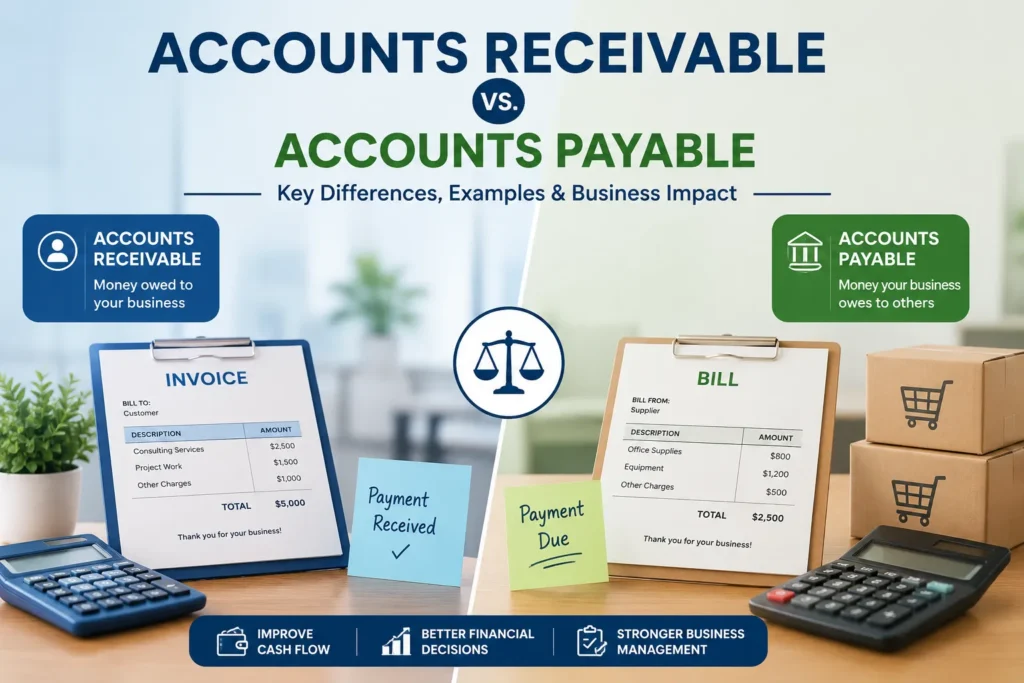
Invoices are sent to customers on a regular basis and bills are received from suppliers on a regular basis. Two key components of normal financial management are accounts receivable vs accounts payable, which keep track of these transactions.
Both have to do with debts owed, but they act in opposite ways. Accounts receivable is money that is owed to a business, accounts payable is money that a business owes.
What is Accounts Receivable?
The accounts receivable meaning is simple: it is the amount of money customers owe a company for products or services that have been delivered.
If the business sells on credit, it would be listed in the books as accounts receivable until the invoice gets paid by the customer.
Common examples include:
- Customer invoices
- Unpaid service bills
- Credit sales
- Outstanding customer balances
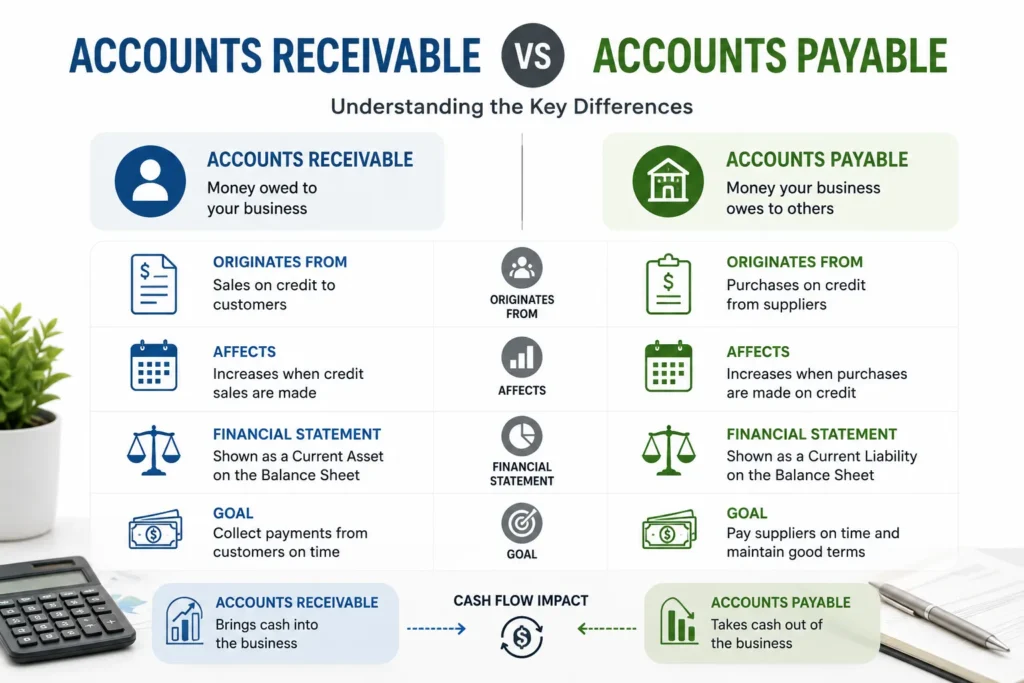
Accounts receivable is normally recorded as a current asset because the business expects to collect the money.
What is Accounts Payable?
Understanding accounts receivable vs accounts payable is important. The accounts payable meaning is the amount of money that a company owes to suppliers, vendors, or service providers.
If a company receives items or services and agrees to pay for them later, the dollar value becomes an account payable until they are paid.
This can include bills from unpaid suppliers, rent, utilities, professional service bills, etc. Generally, Accounts Payable is considered a current liability.
How Does the Accounts Receivable Process Work?
The accounts receivable process begins when a business provides a product or service and sends an invoice.
Typical steps include:
- Create and Send the invoice
- Record the customer’s balance.
- Track deadline of payment.
- Remind as needed
- Take and record receipts for payments
- Reconcile the account
How Does the Accounts Payable Process Work?
The accounts payable process starts when an invoice is sent to the business by a supplier or vendor. Common steps include:
- Receive the invoice
- Check the goods or services
- Check and sign off on the receipt.
- Schedule payment
- Record the transaction
- Reconcile the payment
How Do Accounts Receivable and Accounts Payable Affect Cash Flow?
The relationship between accounts receivable vs accounts payable can directly affect how much cash a business has available.
Accounts receivable affects how quickly cash comes into the business, while accounts payable affects when cash leaves the business. Managing both effectively can help maintain healthier cash flow.
It is possible for a business to look profitable but then have cash flow problems because customers pay slow and suppliers demand fast payment.
What is the Impact on Working Capital?
The usual formula for determining working capital is.
Working Capital = Current Assets − Current Liabilities
Accounts Receivable is part of current assets and accounts payable is part of current liabilities. Effective management of both will contribute to liquidity in the short term. For instance, less overdue customer invoices and negotiating reasonable supplier payment terms can help make cash available, and at the same time help keep it in place.
How Can Better Invoice Management Improve Both Processes?
Strong invoice management can reduce errors, improve payment tracking, and make financial records easier to maintain.
Useful Practices Include:
- Using consistent invoice formats
- Setting clear payment terms
- Tracking due dates
- Automating reminders
- Matching supplier invoices with purchases
- Reconciling accounts regularly
Automation can also reduce manual data entry and improve visibility into outstanding balances.
Accounts Receivable vs. Accounts Payable Examples
Suppose a company provides credit sales of $5,000 worth of services. The $5,000 is seen as accounts receivable until the customer pays.
Now imagine that this same business is issued a supplier invoice for $2,000 to be paid in the next month. This $2,000 is a liability that is reported as accounts payable.
The two transactions illustrate the fundamental difference – one is money that enters the business, the other is money owed by the business.
How Can Businesses Manage AR and AP More Effectively?
Businesses can improve both areas by maintaining accurate records and reviewing outstanding balances regularly.
Practical Strategies Include:
- Automating invoice processing
- Having explicit policies on payment
- Careful study of supplier bills
- Using accounting software
- Cash Flow Forecasting Monitoring
- Reconciling accounts regularly
A well-managed AR and AP process can help businesses make sound financial decisions
Conclusion
Understanding accounts receivable vs accounts payable is essential for managing a company’s short-term finances. AR is for money owed and AP is for money owed by the business.
Having both processes in good order can help you to have better cash flow, working capital, and lower the chances of mistakes, and give you a better picture of the financial health of your company.
Frequently Asked Questions
What is the difference between accounts receivable vs accounts payable?
Accounts receivable is money customers owe a business, while accounts payable is money the business owes suppliers or other vendors. AR is generally an asset, while AP is generally a liability.
What is the accounts receivable meaning in simple terms?
Accounts receivable represents money that a business is owed by customers for a product or service that the business had already sold.
What is the accounts payable meaning?
Accounts payable refers to the amount that a business owes to its supplier, vendor or service provider for goods and services received.
Is accounts receivable an asset or liability?
The account receivables are usually classified as current assets because the business believes that they will be collected by the customers within a short period of time.
Is accounts payable an asset or liability?
Accounts payable is generally a current liability because it represents amounts the business owes and expects to pay in the near term.
What are the main steps in the accounts payable process?
You get an invoice, check that the charges are right, get it approved, schedule the payment, record it in your books, and then reconcile the account to make sure everything matches up.
How do AR and AP affect business cash flow?
AR brings money in — that’s cash coming to you. AP sends money out — that’s cash leaving. Collect faster on what’s owed to you, and time your supplier payments well, and you’ll keep a healthier cash flow.
How do accounts receivable and payable affect working capital?
Receivables are current assets. Payables are current liabilities. Handle both well and you’ll improve liquidity and keep your working capital in good shape.
Why is invoice management important for businesses?
It helps you track what you owe, get paid on time, avoid duplicate or missed payments, cut down errors, and keep your financial records clean and accurate.