
Working capital shows whether a business can cover daily expenses and short-term obligations without cash-flow pressure. Strong sales do not always mean healthy finances if customers pay late or cash is tied up in inventory.
Understanding this measure helps owners manage money more effectively and spot financial problems early. In this guide, you’ll learn its working capital meaning, formula, working capital examples, what to include in working capital, and practical management tips.
What is Working Capital Formula?
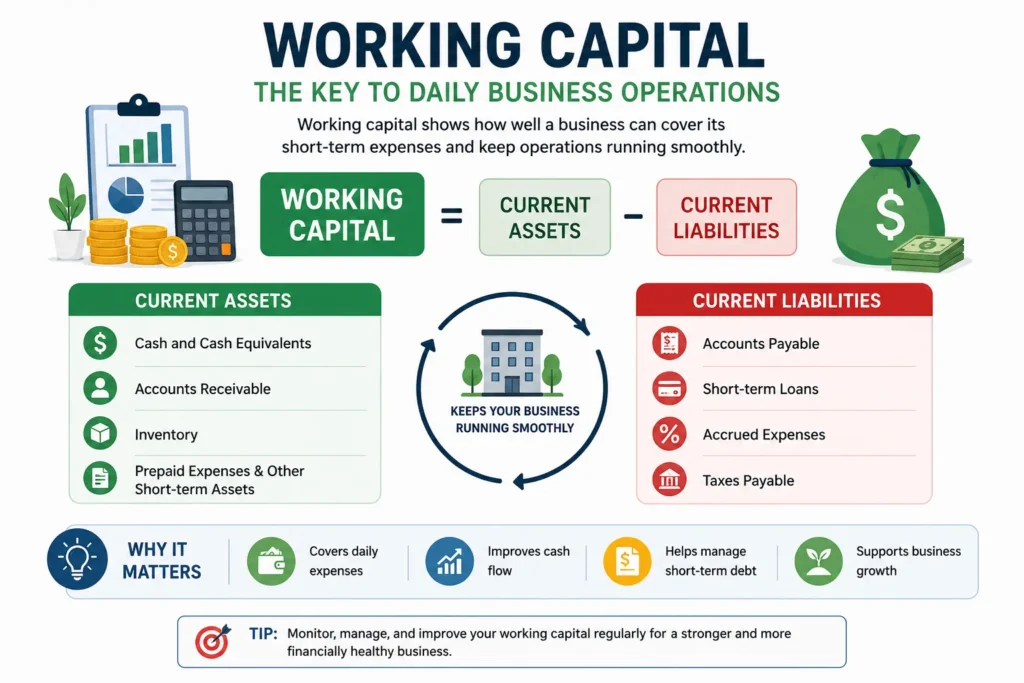
It is the amount that stands between an organization’s current assets and its current liabilities. It indicates the amount of short-term financial capacity an organization can have after adjusting for the immediate obligations.
Meaning
It is the amount of sources of capital that are available for business operations after expenses and short-term debts are taken into consideration.
Current working capital assets can comprise:
- The cash and its equivalents
- Accounts open
- Inventory
- Investments for short-term duration
- Prepaid expenses
The most common current liabilities are:
- Accounts payable
- Credit for short-term needs
- Accrued expenses
- Taxes payable
Formula
Formula that is the basis is:
Working Capital = Current Assets – Current Liabilities
For instance an example, if a firm has $80,000 in capital assets, and $40,000 in its current liabilities:
$80,000 – $50,000 = $30,000
There is $30,000 of working capital.
Why is Working Capital Important?
It is a tool that helps companies manage daily expenses like rent, payroll, invoices, utility bills and purchase of inventory. A regular review of it will help companies determine if the money is tangled to unpaid invoices or stocks that are not being sold.
However, a larger number isn’t always the best. A business should have sufficient liquid resources to run smoothly without having resources lying in the dark.
Examples
Think about two businesses that have the identical amount of capital. A consulting firm may have the majority of its assets in cash and accounts receivable. Retail stores could have the same amount, but store a large portion of it in stock.
While both share the same calculations, their liquidity could differ greatly. This is the reason businesses must examine the condition and availability of their current assets, not just the number they will use.
What to Include In:
Generally, it is recommended to include assets that are short-term and obligations that are anticipated to convert, utilized or settled during an operating period of.
Review:
- Receivables and cash
- Inventory and other assets that are currently in use
- Accounts payable
- Amounts of accrued and short-term debts
How to Improve Working Capital
Businesses can boost their situation in the short term through:
- Paying customers faster
- Reduce the amount of inventory that is unnecessary
- Negotiating better supplier payment terms
- Monitoring the expenses
- Making regular cash flow forecasts
These steps will help you make more money available for the most important activities.
What is Working Capital Accounting?
It’s the process of analyzing current assets and liabilities to determine the short-term financial condition of a business through accounting. It is typically analyzed in conjunction with the balance sheet and cash flow data.
Monitoring regularly can reveal any changes in receivables and inventory, debt and other accounts that are short-term before they cause bigger cash flow issues.
It is also important to consider the speed at which its assets are converted into cash and the time when obligations must be settled. Examining these aspects regularly provides the owners a better understanding of their current financial flexibility.
Conclusion
Working capital can help businesses determine whether they are able to handle short-term obligations as well as daily expenses.The base formula is the current assets less current liabilities. Positive numbers can offer financial flexibility, however the quality of these assets is equally important.
Companies should keep track of the inventory, receivables, cash and the upcoming payment schedule regularly. The improvement of collections and the control of the amount of inventory can improve liquidity in the short term.
Frequently Asked Questions
Why is working capital important?
It’s crucial because it assists businesses in determining whether it has the short-term resources to cover its future obligations. It also helps identify potential cash-flow issues that need to be addressed.
What are three examples of working capital?
Three common examples are cash, accounts receivable, and inventory. These are short-term resources that can support everyday business operations.
What qualifies as working capital?
It generally includes current assets minus current liabilities. Cash, receivables, and inventory are common current assets, while accounts payable and short-term debts are common liabilities.
What is the capital of a company?
For a firm it can be defined as the gap between current assets and liabilities. It is a fundamental measure of the financial flexibility that is available in the short term. .
What expenses are considered capital?
It is not an expense itself, but it funds short-term operating costs such as payroll, rent, utilities, inventory purchases, and supplier payments. These costs are typically part of everyday business operations.
Can capital affect business growth?
Yes. It is possible for a business to struggle to pay for additional inventory, payroll and supplier payment if a large amount of cash is held in other accounts. The management of short-term resources could help to ensure more efficient growth.
How do I calculate working capital?
Use this simple formula: Working Capital = Current Assets − Current Liabilities. Current assets may include cash, inventory, and accounts receivable.
What is the difference between working capital and cash flow?
It compares the current assets to current liabilities and cash flow monitors money that moves through and out of the company. They are both related, but they measure various aspects of financial health.
Can a profitable company have low capital?
Yes. Businesses can earn an income even when they are not able to access short-term liquidity. For instance, sales could be reported when customers haven’t yet paid their invoices.
How can a company increase capital?
A company could enhance its standing by collecting receivables more quickly, reducing costs, managing inventory by negotiating terms with suppliers and keeping adequate cash reserves.